
The process involves the crushing, separation and sieving the gypsum plaster from the paper. The recovered Gypsum can then be re-used in the cement and gypsum industry helping reduce raw material use in new products or in agriculture as a source of Sulphur and Calcium as well as its soil conditioning properties.
Recycled Gypsum and Sulphur
Park House Services Ltd accepts plasterboard waste for processing at Rakehead Transfer Station.


Park House Services NW Ltd Gypsum Recycling
Park House Services NW take in segregated clean plasterboard at our transfer station where we reclaim the gypsum.
At Park House Services we believe key to a good product is accepting only clean material to process.
We work with our suppliers and waste brokers to ensure the plasterboard coming in for recycling is as clean as possible, making our processes more efficient and the product you receive consistent and of good quality.
Our site waste acceptance policy, linked to our Factory production Control document aims to ensure good, clean material enters our processing stream.
Our picking belt operators remove contaminants and foil backed materials as the plasterboard moves through our process. Screens and trommel mesh sizes allow us to process the waste plasterboard to our specifications.
The following is a brief summary of the processes involved in the manufacture of recycled Gypsum material from selected waste materials:
- Incoming loads visually checked on arrival and un-loading.
- Visually checked in the storage bay for contaminants and foil backed board.
- Picking line – contaminants picked for further processing or disposal.
- During picking the product is checked for contamination and particle size at regular intervals.
- The trommel waste output is monitored – paper backing for cleanliness and residual plasterboard. Poorly separated material can be run through again to remove as much plasterboard from the paper backing as possible.
- Contaminants, fibre, paper shred and particle size checked daily when processing.
- Gypsum and waste paper backing are stockpiled in the designated bays.
- Chemical analysis by an accredited laboratory for PAS 109 compliance.
Our testing regime follows the PAS 109 recommendations, on-site visual and physical monitoring during processing and chemical analysis by MCERTs accredited laboratory, all in line with the protocol requirements.

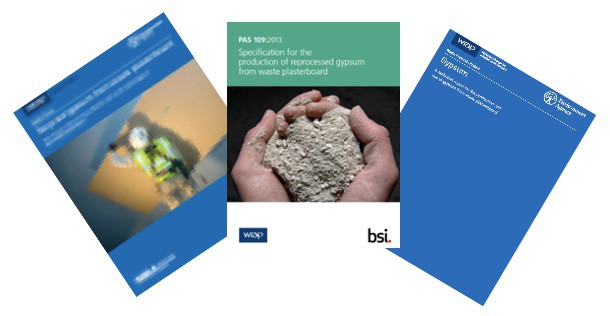
We aim to achieve PAS109 WRAP protocol with our processes and sample our output in line with the WRAP Protocol.
Sulphur for Agriculture
Historically, Sulphur deposition on farmland from the atmosphere was adequate for most crops in the UK thanks to coal fired power generation and domestic coal use.
The switch to low Sulphur coals and natural gas in power generation and a dramatic reduction in domestic coal use, has led to a marked decline in this ‘free’ source of Sulphur. As a result, applications of Sulphur to crops have become an essential part of nutrient management planning for farmers and agronomists. RB209 says that plants need as much Sulphur as the do Phosphorus (RB209 Section1 page 32)
Soils at risk of Sulphur deficiency are typically:
- Loamy and coarse silty soils in areas with >200 mm rainfall between November and February.
- Clay, fine silty or peat soils in areas with >400 mm rainfall between November and February.
Diagnosis of Sulphur deficiency includes paling of young leaves and stunted growth, in OSR pale petals and interveinal yellowing are a signal of Sulphur deficiency.
Tissue analysis is useful in cereals, OSR and grass however the results may arrive too late for remedial action.
Gypsum (Calcium Sulphate) has always been used in agriculture but more recently recycled grades of material have made gypsum more cost effective to farmers as a source of Sulphur nutrition for crops.
Grain Quality
Sulphur supports Nitrogen in the production of proteins, important for high crop yields.
In breadmaking wheat, protein production and protein quality are important for loaf volume.
In brassicas, Sulphur is in glucosinolate compounds, giving them their characteristic peppery taste and reduces the potential of immature rapeseed which attracts a market penalty.
Maize Silage Quality
Sulphur in conjunction with Nitrogen is important in improving protein production in the plant, this is necessary to produce sugars and maximise both dry matter yield and starch content.
Grass Quality
In grass, Sulphur is probably more important for improving the protein quality of grazing and silage than increasing yields, this is important in getting as much production from grass and silage as possible and reducing bought in feed costs.
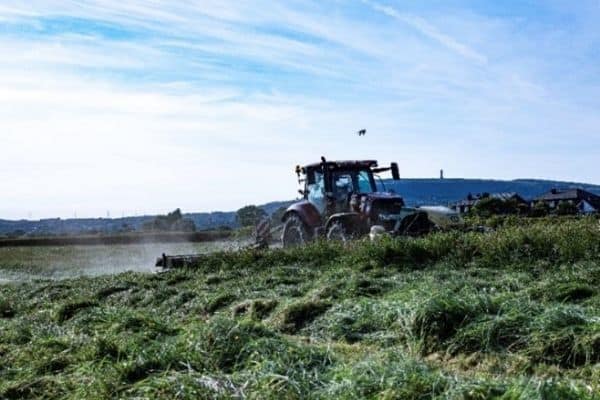
Sulphur recommendations from the Fertiliser Manual RB209.
- Cereals: 25-50 kg SO3/ha.
- Oil Seed Rape: 50-75 kg SO3/ha.
- Peas and Sugar Beet: 25 kg SO3/ha.
- Potatoes: 25 kg SO3/ha in the seedbed
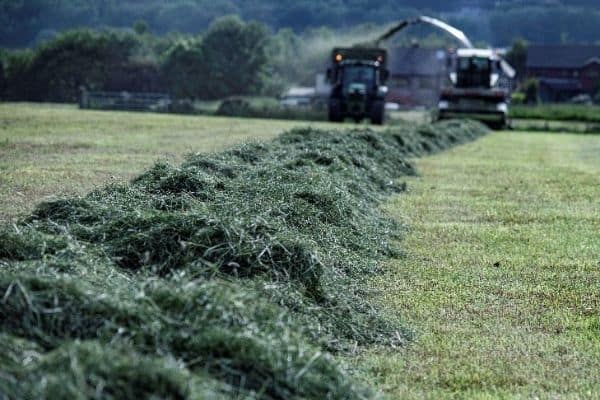
- Grass for Silage: 40 kg SO3/ha prior to each cut. The 2nd and subsequent cuts being most sensitive.
- Grass for Grazing: 20-30 kg SO3/ha in Spring and mid-season.
- *Maize Silage: 20-50 SO3 kg/ha (*MGA – Maize Growers Association) even on medium/heavier soils
Recycled Gypsum use is increasing within the UK. The reduction of atmospheric deposits of Sulphur onto UK agricultural land is driving a need for Sulphur fertilisers.
Sulphur can become one of the main limiting factors to crop yield, where it is important in the uptake and utilisation of Nitrogen.
Recycled Gypsum not only supplies valuable Sulphur, Calcium and Magnesium; the material is also an important soil conditioner.
Advantages of Gypsum for Agriculture
- Improves soil structure and tilth, particularly on heavier soils.
- Gypsum aids the development of a deeper, more friable soil with less hard clods, which can reduce the number of passes and fuel use in seedbed cultivations.
- Increases flocculation of clay particles making soils more permeable with improved drainage, aeration and moisture retention.
- The Sulphur addition from the Gypsum improves Nitrogen use in the crop.
- Reducing soil loss helps reduce Phosphate losses through soil erosion.
- Improves aggregate stability, reducing capping, run-off and soil erosion.
- Allows soils to dry out more quickly following rain, enabling it to be worked sooner.
- Gypsum helps bind organic matter to soil which can help prevent soil erosion.
- Improves skin finish in potatoes with fewer growth cracks.
- Friable soils drop off harvested roots easier as they travel up the harvester web reducing dirt tare and keeping your soil in the field.
- Gypsum is a source of the essential plant nutrients Sulphur and Calcium with both major nutrients readily available.
- The Calcium within Gypsum is more soluble than that from ground limestone, this means the Calcium easily migrates across the soil profile.
- Calcium is an essential nutrient that plays a role in cell division, growth, protein synthesis, carbohydrate transportation and in the structure of plant cell walls.
- Gypsum has a small neutralising value (CaO equivalent between 1-4%), making it particularly useful when increasing soil Calcium levels without needing to alter soil pH.
At the recommended application rate of one tonne/hectare Park House NW recycled gypsum will typically provide the following nutrient quantities:

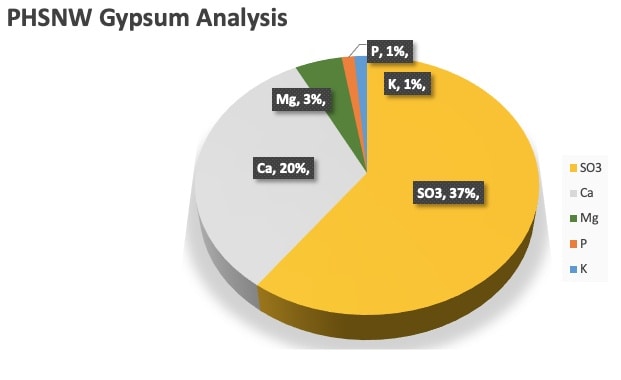
Our recycled Gypsum is a useful source of Sulphur for all crops, released through the growing season due to the material’s natural solubility.
Our material is also low in PTE’s often referred to as ‘heavy metals’ which means no build up in your soil as a result of an application.
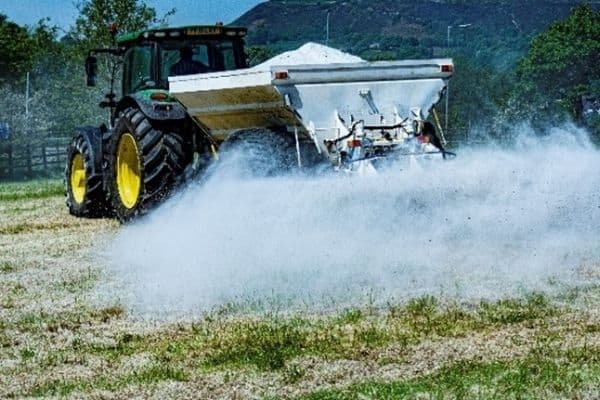
Our recycled Gypsum can be spread accurately using standard rear discharge lime/fertiliser spreading equipment. Ideal for surface application to stubbles and grassland.
Park House Services operate our own tippers and tractor/trailers so we can deliver onto farm when you need it.
We can also spread the material for you using our own lime spreading equipment and operators.
Telephone, e-mail or contact us via this website for more information on how you can fill your sulphur requirements today.

Environmental Information
There is currently a low-risk waste position (LRWP) that applies for storage and spreading recycled certified gypsum from plasterboard (List of Waste code 19 12 12).
Certified gypsum from plasterboard is gypsum that is certified by the manufacturer or supplier to have been produced in accordance with PAS 109.
If you follow the conditions in this LRWP you can carry out the activity without an environmental permit for a waste operation.
- Store waste gypsum in a secure place.
- Store or spread waste gypsum at least 10 metres from any watercourse and 50 metres from any spring, well or borehole.
- Only spread recycled certified gypsum from plasterboard to benefit land.
- Only store up to 30 tonnes of waste gypsum at any one time.
- Only spread up to 1 tonne of waste gypsum per hectare over any 12-month period.
- Only store waste gypsum for up to 12 months before spreading.
LRWP 59 Published 20/08/2019